Inventing Interactive

Archived entries for Microsoft

Productivity Future Vision

s1

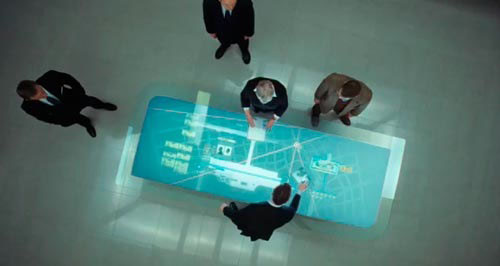
Microsoft recently released a future vision video — looking at how people might get things done 5-10 years in the future. It’s a quite beautifully done piece, full of detail and scenarios. They’ve also put up a website which describes elements of the video in more detail. But what’s surprising is the intensity of the reaction to this vision. It’s getting a lot of abuse. From John Gruber (who further defends this comment in an…
 
Read the rest…

Crazy UIs

excite

Generated Crazy I started the day reading a fascinating article on generative interfaces, “Can Algorithms Help Design the Ultimate Gestural Interface?” At first I thought it was about generating, algorithmically, user interfaces — something I’d love to see. What would a UI that was designed by a computer be like?! (I searched, but closest to this was work on robots generating their own spoken language.) But that wasn’t the case. Instead the article was about…
 
Read the rest…

StarFire

big desk

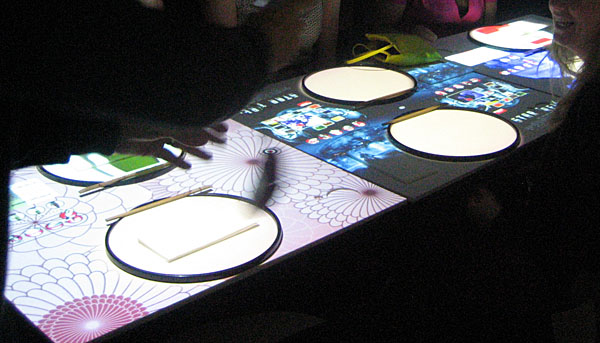
Last week Microsoft demoed Surface 2, the new version of their Surface table. It has some pretty cool features, particularly a technology they call PixelSense, which lets the table visually recognize and scan almost any object placed on it without using cameras. Interactive Things pointed out the similarity to Starfire — a fascinating project I’d never heard of before. StarFire was a future vision film, done in 1992 by Bruce Tognazzini at Sun. It shows…
 
Read the rest…

Hacking Kinect

From labs.laan.com

Microsoft’s just launched Kinect is generating a lot of buzz right now. But it’s not the platform’s games that are most exciting — instead it’s the implications for future gesture-based interfaces. For example, check out Wes Keltner’s article about the possibilities for Gesture-Based Advertising. But I think what’s even cooler is the degree to which designers and programmers are working to hack Kinect and invent all sorts of new applications for the technology, and new…
 
Read the rest…

Designing for Illiteracy

textfree_01

The use of technology, especially mobile phones, in poor and developing countries presents huge opportunities for designers. Mobile banking and microfinancing, as just two examples, can help the poor and unbanked with financial services and business support. But it was only after seeing the work by Indrani Medhi that it I grasped one of the deepest underlying design challenges: many of these people are illiterate. In fact there are over two billion people, worldwide, who…
 
Read the rest…

Street Slide

Street Slide - big hill

This is interesting… Microsoft is working on another cool way of looking at map and street imagery. Unlike traditional street view interfaces where you look at the street through panoramic bubbles (which can be a little disorienting), Street Slide arranges everything as a flat, continuous, photo. When I first saw it, I thought of some Ed Ruscha’s Every Building on The Sunset Strip (1966). Street Slide gives you a great slide-scroller view of streets. Plus……
 
Read the rest…

Life Moves Fast

Palm: Interacting with the projection

Take a look at this series of commercials from Palm, part of their “Life moves fast. Don’t miss a thing” campaign. They show a kind-of augmented reality, holographic-style mobile UI. Unlike the Chase Blueprint ads, which showed some pretty innovative ideas for holographic interfaces, these essentially project what’s happening on the screen. The point isn’t to present a new interface — instead it’s about communicating how you can use a mobile interface while you’re on-the-go….
 
Read the rest…

Manual Deskterity

Pen and touch

Check out this interesting video from Microsoft Research on using a pen and touch together in an interface. It’s part of Microsoft Research’s Manual Deskterity project. Running on Microsoft Surface, the demo has some really cool examples of how a specific pointing device can be combined with the more general input of touch. Using the pen to write, to peel copies, as an exacto knife, a straight edge, and lots more. At some point the…
 
Read the rest…

Complexity and Quantum of Solace

Quantum of Solace

In What Movie UIs Say About the Future, Tony Walt reviews a variety of interface types featured in some recent movies. His discussion on Complexity was particularly interesting — especially in the context of the iPad and its move towards simplicity: I’ve noticed that UIs in feature films are continually getting more elaborate and complex. Meanwhile, though, real-world interfaces are getting more simple and intuitive. It seems an odd contradiction that the futuristic UIs we…
 
Read the rest…

Windows Phone 7 Series

winmobile_01

The announcement this week of Microsoft’s Windows Phone 7 Series has been getting a lot of attention. And, the reviews have been generally positive. It’s funny how, as designers, we’re so often skeptical about Microsoft. My friend Eric Brown saw the announcement and emailed me, asking, “Am I crazy for liking this?” I feel the same way. It’s not often that we say something positive about Microsoft. But this new phone OS is a refreshing…
 
Read the rest…


 Home.   RSS Feed.    @i_interactive on Twitter. This blog is powered by Wordpress. The theme is based on Modern Clix. The "ii" logo is by TDOOKK.